
The chart was beautiful. The question was wrong
Four steps to take a vague ask to a sharp one - and about 60% don't survive the second

It’s a Monday, and a message from your VP lands in Slack: “How’s our new membership doing? Leadership wants an update by Thursday.” You read it twice. It’s a reasonable ask - you get one like it every week - but it’s not really a question yet, just a direction to go look in.
The instinct is to go get it. You open the warehouse, or now, hand the whole thing to the AI and start pulling data - adoption, retention, a chart or two, something clean enough to paste into a deck. And you’ll get something back, which is the trap. A vague ask always gives you an output that looks like an answer, whether or not it answers anything.
So I’ve learned not to go get the answer - I sharpen the ask first. There are four steps between a vague request and a question that’s worth an hour - goal, decision, metric, hypothesis - and working through them kills as many questions as it sharpens. Let me walk through this one.
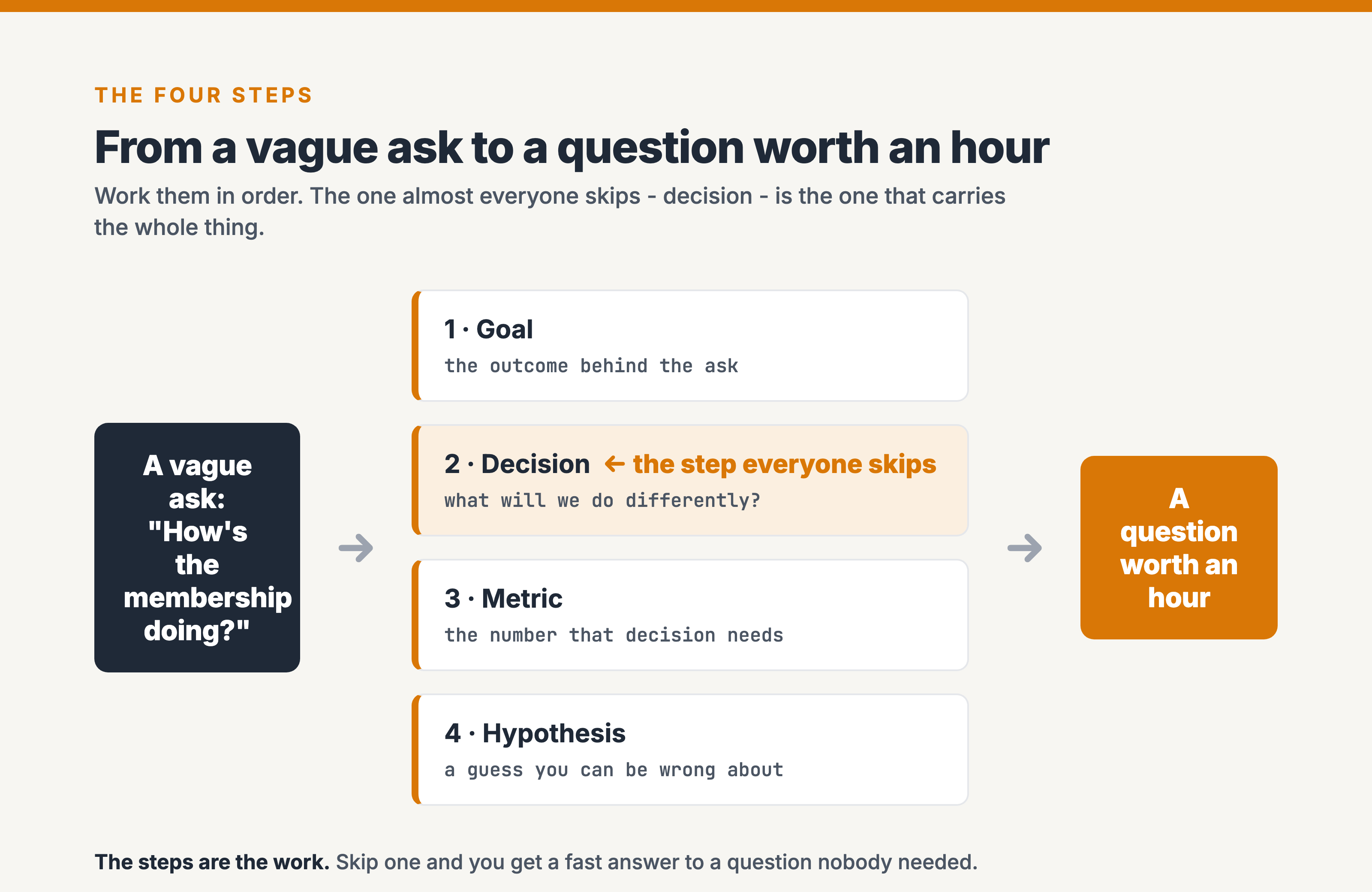
The four steps from a vague ask to one worth an hour. The one everyone skips - decision - is the one that carries it.
The first step is the goal: the outcome the leader actually cares about, which is never “an update.” An update is a deliverable. Nobody wants a deliverable - they want to know something, and “an update” is just the stand-in they reached for. Strip the ask down and the goal is usually simpler than the wording: they want to know whether the membership is still worth the company’s time. Name that, and the ask already looks different.
Then comes the step almost everyone skips, and it’s the one that carries the whole thing: the decision. The goal implies a fork - invest more in the membership, or move that effort somewhere it pays back faster - and no analysis is worth an hour unless a choice like that is waiting on it. So before I pull anything, I ask the one question that collapses most requests: what decision are you trying to drive with this?
About 60% of the time, asking that out loud makes the person realize there was no real decision underneath, and they tell me not to bother. That’s the whole point. Most of what this does is kill questions early, before they cost anyone an afternoon. It’s an easy step to skip, because the metric step feels like real work - numbers, a chart, something to show - and the decision step feels like a meeting with nothing to show for it. So people skip to the dashboard, and that’s how the ones nobody opens get built.
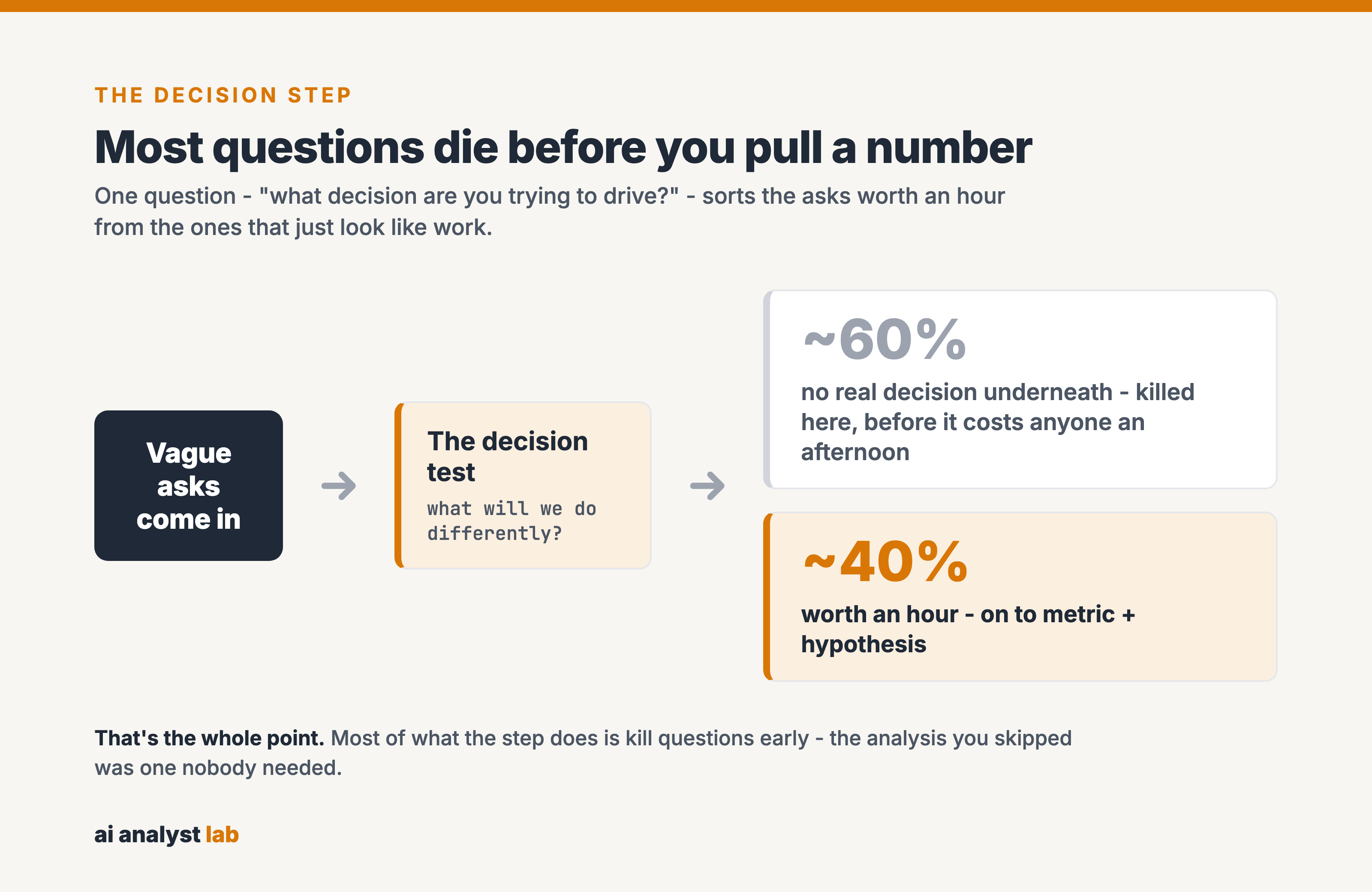
Ask “what decision are you trying to drive?” and about 60% of requests don’t survive it. That’s the point.
The usual pushback is some version of “I’m just exploring,” and that’s fair - not every look at the data hangs on a decision due this week. But most exploring is a decision in disguise, so I reframe instead of folding. “I’m just exploring user behavior” becomes “what patterns would change our next sprint’s priorities?”; “I’m just looking at the data” becomes “what would I need to see to recommend we invest in this?”; “I don’t have a decision yet” becomes “then what’s worth investigating further - and that’s your decision.” That step is what points everything after it.
Once a question clears the decision, the metric gets easier - and the word to watch out for is “engagement.” Engagement would have felt like an answer and settled nothing. Invest-or-redirect wants two real numbers instead. The first is adoption: of the members who could use the new thing, how many ever touched it. The second is the one people leave off - whether the members who used it stuck around, or spent more, than the ones who didn’t. Adoption on its own is a vanity metric. Retention is the number that tells you whether it mattered.
The last step is a hypothesis - a guess specific enough to be wrong. Mine, going in: adoption is low because the feature is buried three taps deep, and the handful who find it retain better than average. Now the pull has a shape. If I’m right, the fix is discovery, and the membership earns more investment. If I’m wrong, I find that out cheaply and move on. Either way I can be wrong about it out loud, and that’s what makes it worth effort.
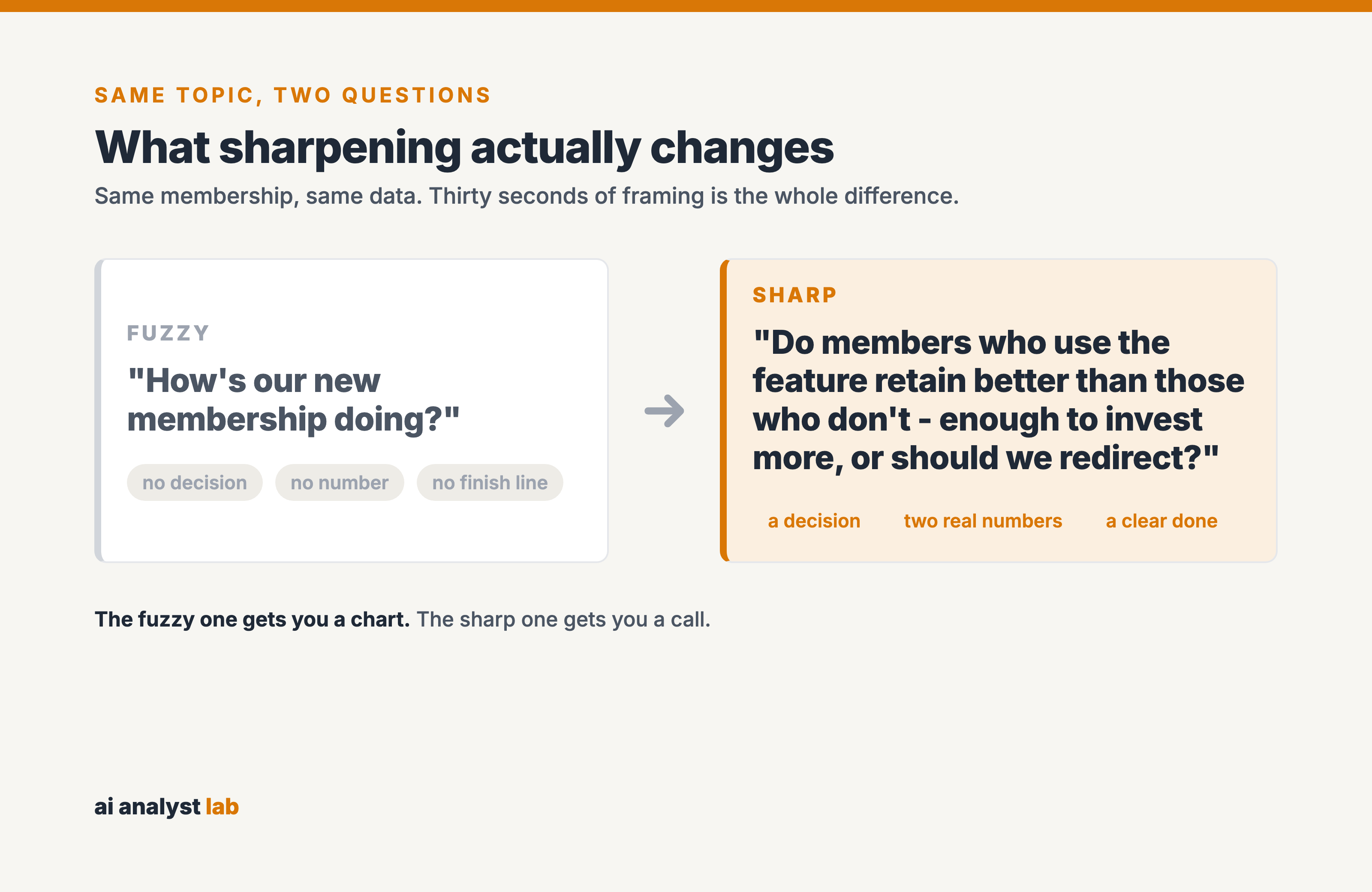
Same membership, same data. Thirty seconds of framing is the whole difference.
This is the part the AI won’t do for you. Hand it the raw ask - “how’s the new membership doing?” - and it answers from right there, fluently, without doing any of the work first. And the fluency is the problem. A clean answer feels settled, and that feeling is what stops you from asking whether the question was any good in the first place. A good analyst who knew your company would push back. Now that the answer is basically free, getting to the right question is the hard part.
The pull is fast now. Anyone can get an answer in the time it takes to type the ask. What’s still slow is deciding whether the answer is worth having, and most of the time an honest look ends with you not pulling any data at all. That part is still yours.
If you’re curious about framework like this to sharpen your analytical thinking and foundation, join us at our next AI Analytics for Everyone 5-week course where we help professionals become analytically independent while delegating execution to AI.
Or just hit reply and tell me the fuzziest ask sitting on your plate this week.